Protecting Minors from Digital Platform Addiction: A Joint Greece, Spain Stance at MWC 2026
On the third day of MWC Barcelona, two governments converged on the defining digital policy test of 2026.
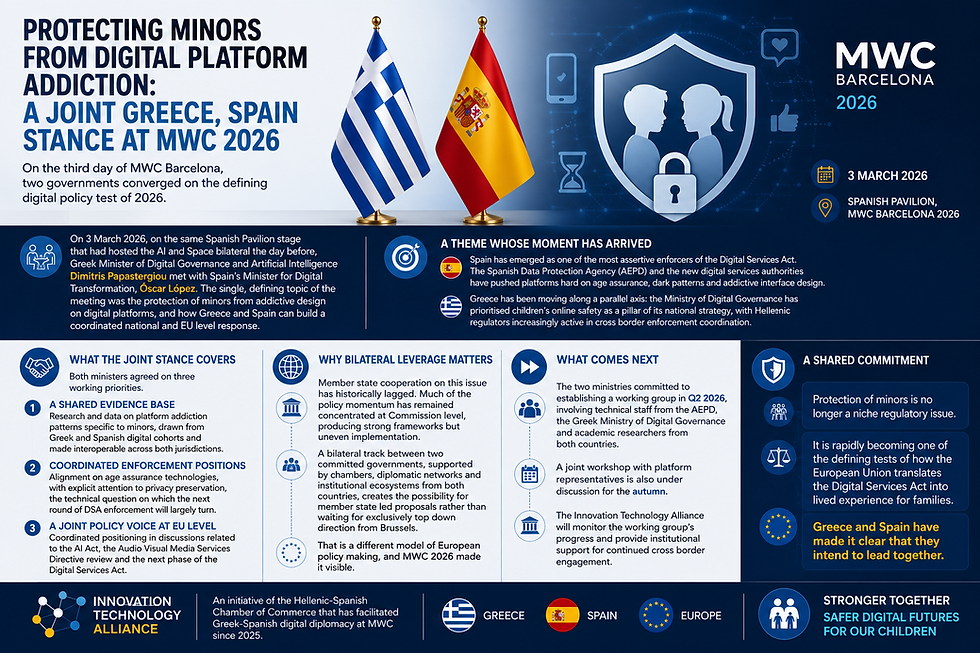
On 3 March 2026, on the same Spanish Pavilion stage that had hosted the AI and Space bilateral the day before, Greek Minister of Digital Governance and Artificial Intelligence Dimitris Papastergiou met with Spain’s Minister for Digital Transformation, Óscar López. The single, defining topic of the meeting was the protection of minors from addictive design on digital platforms, and how Greece and Spain can build a coordinated national and EU level response.
A theme whose moment has arrived
Spain has emerged as one of the most assertive enforcers of the Digital Services Act. The Spanish Data Protection Agency (AEPD) and the new digital services authorities have pushed platforms hard on age assurance, dark patterns and addictive interface design.
Greece has been moving along a parallel axis: the Ministry of Digital Governance has prioritised children’s online safety as a pillar of its national strategy, with Hellenic regulators increasingly active in cross border enforcement coordination.
What the joint stance covers
Both ministers agreed on three working priorities.
1. A shared evidence base
Research and data on platform addiction patterns specific to minors, drawn from Greek and Spanish digital cohorts and made interoperable across both jurisdictions.
2. Coordinated enforcement positions
Alignment on age assurance technologies, with explicit attention to privacy preservation, the technical question on which the next round of DSA enforcement will largely turn.
3. A joint policy voice at EU level
Coordinated positioning in discussions related to the AI Act, the Audio Visual Media Services Directive review and the next phase of the Digital Services Act.
Why bilateral leverage matters
Member state cooperation on this issue has historically lagged. Much of the policy momentum has remained concentrated at Commission level, producing strong frameworks but uneven implementation.
A bilateral track between two committed governments, supported by chambers, diplomatic networks and institutional ecosystems from both countries, creates the possibility for member state led proposals rather than waiting for exclusively top down direction from Brussels.
That is a different model of European policy making, and MWC 2026 made it visible.
What comes next
The two ministries committed to establishing a working group in Q2 2026, involving technical staff from the AEPD, the Greek Ministry of Digital Governance and academic researchers from both countries.
A joint workshop with platform representatives is also under discussion for the autumn.
The Innovation Technology Alliance will monitor the working group’s progress and provide institutional support for continued cross border engagement.
Protection of minors is no longer a niche regulatory issue. It is rapidly becoming one of the defining tests of how the European Union translates the Digital Services Act into lived experience for families.
Greece and Spain have made it clear that they intend to lead together.