Microsatellites Going Mainstream: How Greek and Spanish Space Industries Are Converging
Two weeks before MWC Barcelona 2026 opened, Sateliot and PLD Space signed Spain’s first 100% private space mission. Greece is moving on a parallel arc. The Greek, Spanish space conversation is no longer theoretical.

On 17 February 2026, Spanish operator Sateliot and Spanish launcher PLD Space signed their first commercial contract: two next generation Tritó 5G direct to device satellites, approximately 160 kg each, to be launched on a dedicated MIURA 5 mission in 2027. The contract is, by some distance, the most significant single commercial milestone in modern Spanish space history. It is the first 100% Spanish private space mission, national manufacturing, national launch, national operations and national commercialisation. Two weeks later, Spain hosted MWC Barcelona 2026.
PLD Space’s 2026 momentum. In early March 2026, PLD Space closed a €180 million Series C round led by Mitsubishi Electric. On 7 April 2026, the European Investment Bank announced a €30 million venture debt loan to PLD Space, the EIB’s first direct investment in a small scale space launcher. Total 2026 capital raised: approximately €210 million. Sateliot, headquartered in Barcelona, operates Europe’s first 5G satellite centre and is developing the Tritó constellation for direct to device IoT services.
Greece’s parallel arc. Greece’s National Microsatellite Programme, designed by the Hellenic Ministry of Digital Governance through the General Secretariat for Telecommunications and Posts and the Hellenic Space Centre, has a total budget of €200 million and a target of seven Earth observation satellites by 2026. Five are already in orbit. The Lavrio Technology Park hosts DAEDALUS, the supercomputer at the centre of the Pharos AI Factory. Open Cosmos Aegean has unveiled production facilities for a high resolution satellite constellation. The Greek satellite industry is moving from project based work to programmatic capacity at the same time that Spain’s commercial space industry is consolidating.
Why the convergence matters.Both countries are building Mediterranean relevant Earth observation capacity, climate monitoring, maritime traffic, fire prevention and agricultural intelligence. Both have major stakes in the IRIS² constellation programme, Europe’s secure connectivity backbone, where Greek and Spanish industrial interests align more than they compete. Both countries also have an opportunity to position bilateral cooperation as a working model for distributed, member state led European space innovation.
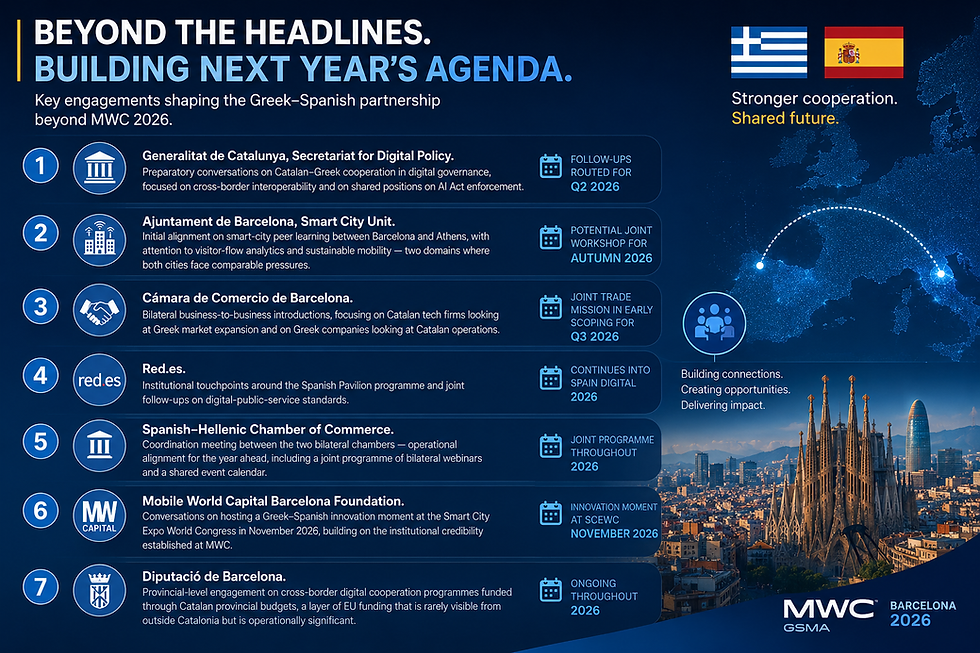
What MWC 2026 opened.The bilateral meeting on AI and Space between Minister Papastergiou and Spanish Deputy Minister Juan Cruz Cigudosa explicitly placed space cooperation alongside AI Factories on the bilateral working agenda. The Innovation Technology Alliance will publish a directory of Greek and Spanish space tech actors with active EU funding bids during Q2 2026, designed to make matchmaking between the two ecosystems concrete rather than abstract.
The contracts in Spain are signed. The supercomputers in Greece are being installed. The bilateral conversation has finally caught up with the underlying industrial reality.