AI Factories and AI Giga Factories: What Greece and Spain Discussed at MWC 2026
On the second day of MWC Barcelona 2026, Greece and Spain held one of the most consequential bilateral conversations of the week.

On 2 March 2026, on the floor of the Spanish Pavilion, Greek Minister of Digital Governance and Artificial Intelligence Dimitris Papastergiou met with Spain’s Deputy Minister for Science, Innovation and Universities, Juan Cruz Cigudosa. The agenda was deliberately concentrated: AI Factories, AI Giga Factories, advanced technologies cooperation and the space sector. There were no broad declarations. There was, instead, a working alignment between two governments that have decided to move in the same direction on European AI infrastructure.
Why this matters.The European Union’s AI Factories network, public compute infrastructure designed to give startups, SMEs and researchers access to large scale GPU resources, is a defining piece of the bloc’s digital sovereignty agenda. Spain hosts the Barcelona Supercomputing Center, one of the network’s flagship sites, and the new Centro Nacional de Inteligencia Artificial (CENIA). Greece operates GRNET as the national HPC backbone and is steadily building applied AI capacity through Demokritos and the Athens research cluster. Aligning these capabilities, through interoperability, shared benchmarks and joint participation in EuroHPC calls, is now within practical reach.
What was agreed.The two sides set the foundation for working level coordination on three specific tracks. First, joint applications to upcoming EuroHPC and Horizon Europe calls, with a shared position on which instruments are most relevant for Mediterranean relevant AI use cases. Second, talent pipelines that allow Greek and Spanish researchers to use each country’s compute resources, modelled on existing EuroHPC access mechanisms but with bilateral acceleration. Third, coordinated positioning on AI Giga Factories, the next generation compute clusters that the European Commission is designing for frontier model training, where the question of which member states co lead bids is now strategically live.
Beyond AI.The conversation also extended to space technology, a domain where both countries have moving capability. Spain’s New Space ecosystem, Sateliot, PLD Space, FOSSA Systems, Alén Space, alongside the broader GMV Innovating Solutions footprint, has accelerated visibly over the past three years. Greek aerospace has its own track, anchored by the Hellenic Aerospace Industry and a growing layer of microsatellite work emerging from Greek research centres. Both ministries acknowledged that secure connectivity, shaped by the IRIS² constellation programme, and Earth observation tailored to Mediterranean realities are areas where bilateral leverage is real.
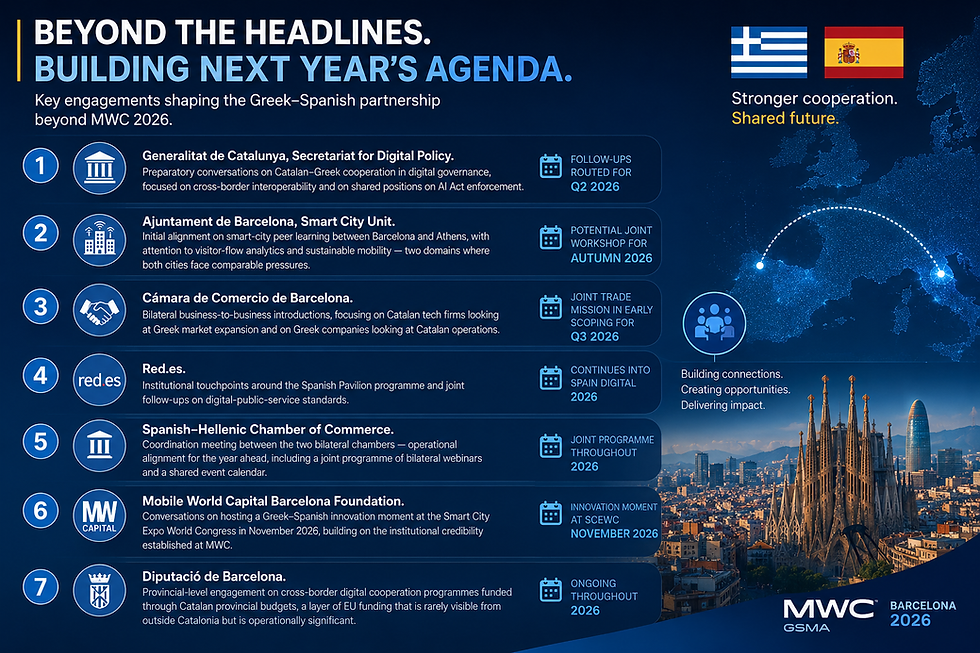
The bilateral produced a shared list of EU instruments to pursue jointly, a working understanding of where each country’s strengths complement the other’s, and the institutional intent to keep the rhythm going through the rest of 2026. The next operational checkpoints, joint scoping notes on EuroHPC bids and on the AI Giga Factories programme, fall in Q2.
The Innovation Technology Alliance, an initiative of the Hellenic, Spanish Chamber of Commerce that has facilitated Greek, Spanish digital diplomacy at MWC since 2025, will be tracking the follow up and reporting publicly through this microsite.